by HiServWebdev | Jul 2, 2024 | Gas COC, Gas Installations, LPG Rules and Regulations
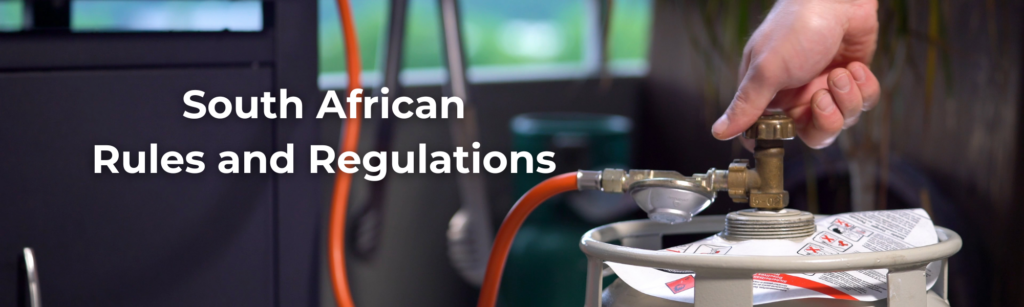
Working with LPG is a significant responsibility, and as a result, South Africa has a set of rigorous rules, standards and regulations that must be adhered to. These regulations are mainly designed to adhere to industry safety standards and to protect you as an end user of any gas appliance. Receiving a gas certificate of compliance for any fixed gas line and gas appliance installations is a component of these regulations.
In this article, we are taking a brief look at the basic safety regulations surrounding a gas certificate of compliance and why they are important.
What is a gas certificate of compliance?
The short answer is that it ensures all gas installations and appliances are safe and, as a result, comply with the South African National Standard (SANS).
To quote the South African Qualification and Certification Committee (SAQCC): “According to the regulations that were introduced in 2009, all gas installations must have a Certificate of Compliance (COC) according to the Pressure Equipment Regulations that have been promulgated under the Occupation Health and Safety Act (No 85 of 1993) – effectively stating that the installation has been properly inspected and is determined to be safe and leak free.”
What is a fixed gas supply?
A fixed gas supply is the gas line that is installed with your gas geyser, gas fireplace, or a built in gas hob, or gas stove. The most straightforward method of comprehending the concept of a fixed line is to note that it is not feasible to detach it and take it camping. It is not portable and cannot be transported. When an LPG supply line is not permanently installed, the orange pipe is typically connected directly to the gas hob, and both are transportable or moveable.
When do you need a gas certificate of compliance?
You need a gas certificate of compliance when you:
- Make a change or adjustment on a fixed gas line installation.
- When you change a gas appliance.
- When you add gas appliances.
- Sell and transfer properties that have a fixed gas line and gas appliances.
What basic rules and regulations apply to gas installations?
General LPG regulations:
- Maximum LPG Allowed per property:
- Up to 9kg is allowed inside an apartment.
- Up to 19kg is allowed inside a freestanding house.
- Up to 100kg is allowed outside a building on any earth but this may be subject to the local municipal bylaws which differ from area to area.
- If an excess of 100 kg must be stored on your premises, a special application will have to be submitted at your local Fire and Safety Department. (See image with more details here.)
- LPG gas hoses to connect to cylinders must be replaced at every 5 years or sooner if they show any cracks in the surface.
- Regulators may not be older than 10 years.
- All gas appliances and installations should be inspected for leaks and safe operation every 12 months.
- Only SABS approved appliances with a valid permit number (LPGSA safe appliance verification)
Regulations for gas fix supply:
- Must be installed by an accredited LPG service provider.
- LPG bottle must be placed on a solid and stable surface.
- Must never be placed in a garage.
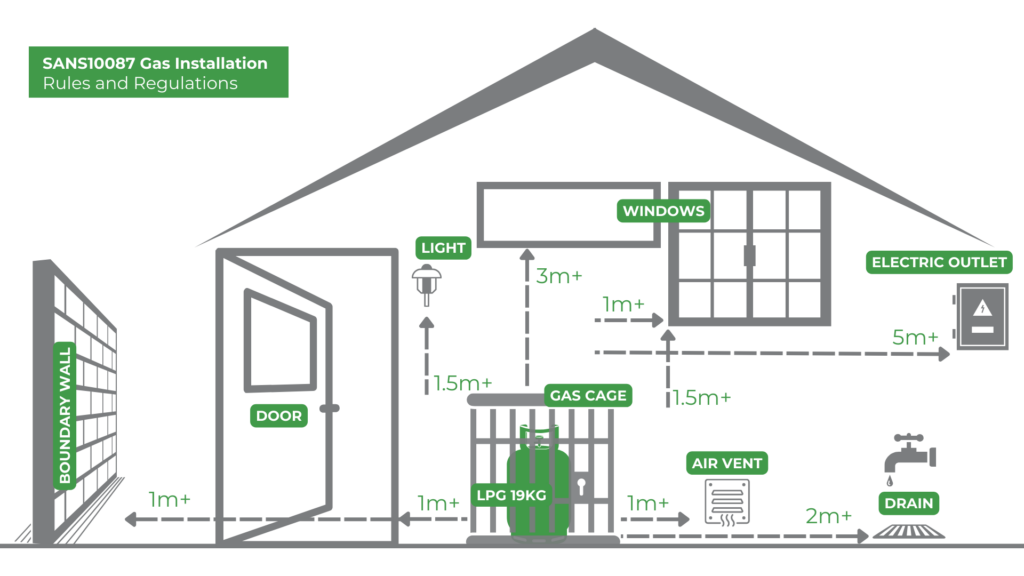
- See the image for the safety distances outside:
- No less than 1 metre sideways from doors and windows (unless a boundary wall is installed).
- No less than 1 metre from an air vent.
- No less than 2 metres from drains, manholes or pits.
- No less than 3 metres below windows unless a non-combustible roof (corrugated roofing or nutec boards) has been installed between the gas bottles and the bottom of the window may be reduced to 300mm.
- If a non-combustible roof is installed, it may be reduced to no less than 1.5 metres.
- No more than 2 cylinders are used, no less than 1 metre from the property boundary wall unless it is a fire wall, in which case the cylinders may be placed directly against the boundary.
- No less than 5 metres sideways away from an electrical source such as an electrical point, plug switch, socket, electrical motor, or pool pump etc.
Any outdoor light, no less than 1.5 metres above the gas cylinder valve.
For more regulations with the City of Cape Town, please find them here.
Regulations for gas hob and stove installations:
- Install appliances on a firm, solid, and level foundation.
- Do not install a gas appliance in a strong draught that will extinguish a burner set on a low flame.
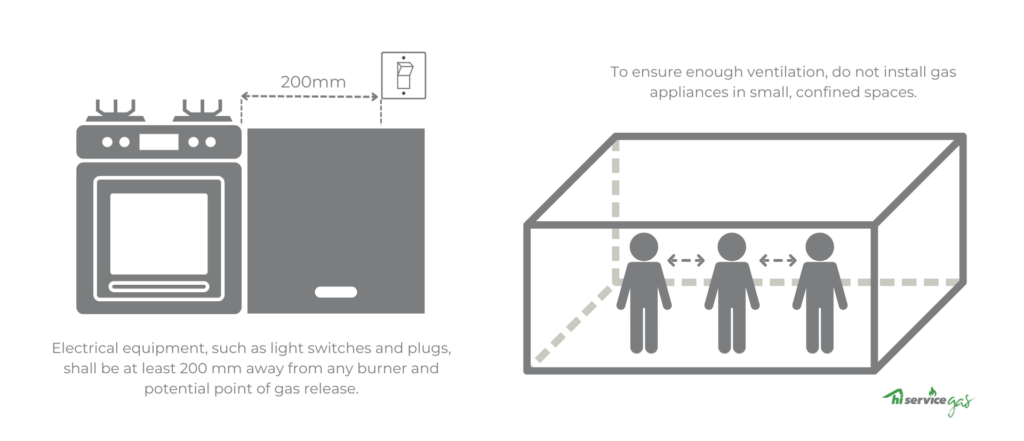
- To ensure enough ventilation, do not install gas appliances in small, confined spaces.
- Ensure that the gas appliances are not situated in a space where combustible furnishings or ignitable materials can be set on fire. For example, gas hobs cannot be installed near curtains or cleaning materials.
- Electrical equipment, such as light switches, stove isolator and plugs, should all be at least 200 mm away from any burner and potential point of gas release.
See more images here.
You can further your knowledge of South African rules and regulations for successful gas appliance installations in our blog here.
What will a gas compliance certificate cost?
We cannot speak for other companies, but at Hi Service Gas, a gas compliance certificate inspection costs R661.25
If any repairs or modifications are necessary, we will provide a quote. Once the gas line or appliances have been brought up to standard, we can proceed with issuing the gas COC.
(*rate provided in June 2024 – subject to change.)
How will I receive a gas COC?
Once a full inspection has been concluded and all tests have been passed, you will receive a gas COC.
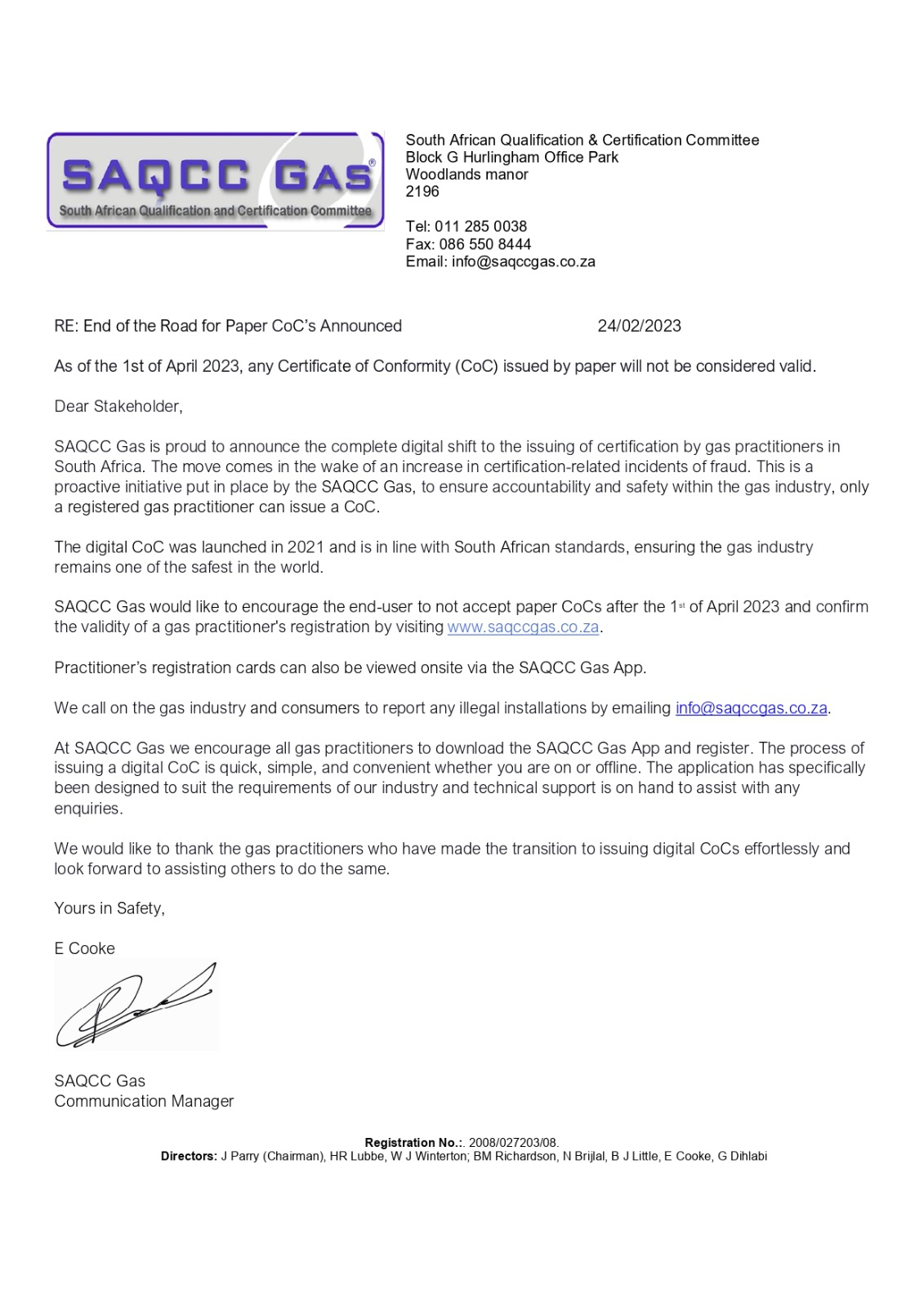
Gas COCs are no longer issued in paper format but are now directly issued online via e-mail. You can read the information in this letter by the SAQCC.
What must I do if my gas appliances or gas lines are not compliant?
Ask a registered gas installation company to fix all the issues, make the changes and repairs where required. The licenced LPG installation professionals will then automatically provide the COC after the repairs are completed.
Safety Tip: You should never attempt to fix gas-related issues yourself.
Hi Service Gas is certified and has vast experience to assist with residential and commercial gas COC inspections, gas compliance certificates, gas installations, SABS approved gas appliances, and repairs.
Call us when you need great gas.
Hi Service Gas – Simplicity and Efficiency Beyond Electricity.
This article was written by a human.

by HiServWebdev | May 28, 2024 | Gas Appliances, Gas Geyser, Gas Installations, Geysers
Tankless gas geysers used to be the tiny box you used to get instant heat when you washed dishes in the kitchen, but technology has advanced so dramatically that you can run an entire hot water system for a hotel from gas geysers only. Gas geyser installations are popular in South Africa because of three key factors: the drive for energy independence, environmental responsibility, and cost savings.
Liquefied petroleum gas (LPG) offers a compelling alternative to other heating systems. Unlike solar, it doesn’t require expensive upkeep or battery backups. Certain models also function independently of the national grid, providing hot water even during power outages. And when it comes to fossil fuels, LPG boasts the cleanest burning profile.
This article delves deeper into the world of gas geysers, exploring their numerous benefits, helping you determine the right size unit for your building, and recommending a reliable brand to consider.
What are the benefits of gas geysers?
- The system is tankless, meaning the gas geysers do not store and reheat water like traditional electrical geysers.
- Instant hot water on-demand.
- The water pressure is stable.
- Reduced cost vs. an electric geyser.
- Energy efficiency.
- Reduced carbon footprint.
- Selected models are off-grid; therefore, power outages do not interrupt heating water. For others, a backup power system is available.
- Flame-failure safety technology ensures safe use.
- A compact, space-saving design to fit neatly against the wall, whether it is an internal or external installation.
- It is covered by insurance if the gas geyser installation is done by a gas-certified business.
What size gas geyser should be installed to meet your requirements?
Here’s a brief overview, but we are happy to provide a free quote tailored to your water heating needs for any property size.
Commercial use
For commercial applications, we can install systems such as combining 10 x 26-litre geysers connected to the water supply. This setup ensures instant hot water for your employees or guests.

Here’s a chart for household or domestic use
- 5l Gas Geyser: One Basin (Great for camping)
- 8l Gas Geyser: One Basin or Shower
- 10l Gas Geyser: One Basin or Shower
- 12l Gas Geyser: One Basin and Shower
- 16l Gas Geyser: One Basin, Bath and Shower
- 20l Gas Geyser: One Kitchen and One to Two Bathrooms
- 26l Gas Geyser: One Kitchen and Two to Three Bathrooms
- 32l Gas Geyser: One Kitchen and Three to Four Bathrooms
Which gas geyser brand is the most reliable?
Hi Service Gas prioritises quality and customer satisfaction. We offer a variety of “Tested and Trusted” brands, ensuring reliability, good after-sales service, and part availability. We even extend warranties beyond manufacturer guarantees.
Top Brands for Different Needs:
- Paloma (Japan): Our top seller, known for comfort, longevity, and a great warranty.
- Dewhot: Affordable and economical option.
- Typhoon: Offers additional technological features.
Paloma is a well-known high-end gas geyser brand.
For today’s discussion, we will provide details and specifications about Paloma gas water heating systems to provide a greater understanding of what a gas geyser installation will bring to your table.

- Supplies: One kitchen, one to two bathrooms
- Installation: Type D Outdoor Wall Mounted
- Water Operating Pressure: 0.80 to 10 Bar
- Water Temperature Range: 37°C–75°C
- Flow Rate: 20 l/min
- Power Supply: AC 240V
- Solar Compatible: Yes
- Energy Efficiency: Up to 87% (6 star rating)
- Remote Control: Yes up to 25 metres
- Back-Up Power: Lithium Battery, sold separately
- Size: 520mm (H) x 355mm (W) x 187mm (D)
- Maintenance Required: Every 2 Years Limited Service, 5 Years Major Service
- Warranty:
- Domestic: 10 Year warranty on copper heat exchanger; 3 Year warranty on gas components; 3 Year on water components; 1 Year on electrical components.
- Commercial: 1 Year on all parts and components
- Supplies: One kitchen, two to three bathrooms
- Installation: Type D Outdoor Wall Mounted
- Water Operating Pressure: 0.80 to 10 Bar
- Water Temperature Range: 37°C–75°C
- Flow Rate: 26 l/min
- Power Supply: AC 240V
- Solar Compatible: Yes
- Energy Efficiency: Up to 87% (6 star rating)
- Remote Control: Yes up to 25 metres
- Back-Up Power: Lithium Battery, sold separately
- Size: 520mm (H) x 355mm (W) x 187mm (D)
- Maintenance Required: Every 2 Years Limited Service, 5 Years Major Service
- Warranty:
- Domestic: 10 Year warranty on copper heat exchanger; 3 Year warranty on gas and water components; 1 Year on electrical components.
- Commercial: 1 Year on all parts and components
Embrace Efficiency and Freedom with Gas Geysers
Gas geysers offer a compelling combination of benefits for South Africans. Their on-demand hot water, energy efficiency, and ability to function off-grid make them ideal for those seeking independence, lower costs, and a reduced environmental impact. From reliable brands like Paloma to various sizes for any need, gas geysers empower you to enjoy the comfort of hot water while aligning with South Africa’s drive for a more sustainable future.
Extra Resources and Downloads:

by HiServWebdev | May 2, 2024 | Gas Appliances, Gas Installations, Gas Space Heaters
As the chilly winter months approach, finding effective heating solutions becomes a top priority for many households. Gas space heaters offer a convenient and efficient way to warm up living spaces, providing quick heat without the need for extensive installation or reliance on electricity.
In this article, we’ll explore the best gas heaters available in South Africa, considering their heating output, features, and suitability for different room sizes and requirements.
Heating Output Guidelines:
Before delving into specific gas heater models, it’s necessary to understand the heating output requirements for different room sizes. Here’s a quick overview:
- Heat output of 2.9–4.2 kW heats a small room between 40 – 42m².
- Heat output of 3.4–6.6 kW heats a medium room between 46-66m².
- Heat output of 5.2-8.2 kW heats a large room between 52 – 82m².
Our Top Gas Heater Solutions are:
1. Bromic Supaheat II Gas Heater
The Bromic Supaheat II gas room heater is a standout choice for effectively heating various living spaces. With its sleek silver-grey finish and natural convection heating mechanism, this heater can quickly warm up rooms ranging from 60 to 70 square metres.

Notable features include:
- Six panels for efficient heat distribution.
- Battery ignition system.
- Flueless design, suitable for all rooms except bedrooms and bathrooms.
- Portable gas heater.
- Quick coupler section for easy relocation without moving gas bottles.
- 1500mm bayonet gas hose included for the quick release system.
- 5.3 kW Heat Output.
- Available in both natural gas and LPG variants.
- Approved by Australian and South African Gas Associations.
2. Rinnai Avenger 25 Convector
Ideal for large open-plan living areas, the Rinnai Avenger 25 Convector gas heater delivers powerful heating performance with low emissions. With features like a programmable timer, remote control, and safety systems, it offers both comfort and peace of mind.

Notable features include:
- Suitable for spaces ranging from 53m² to 97m². (Season depending)
- Electronic ignition controls with a thermostat for precise temperature regulation.
- Four programmable timers.
- Available in White or Platinum Silver colors.
- Remote control operation for convenience.
- Safety systems, including oxygen depletion and flame failure, shut down.
3. Enduro 13 Convector
For smaller living areas, the Enduro 13 Convector gas heater offers an economical and efficient heating solution. With its portable design and low emissions technology, it’s perfect for medium-sized open-plan living spaces.

Notable features include:
- Suitable for areas up to 51m².(Season depending)
- Safety systems, including oxygen depletion and flame failure, shut down.
- Delay on timer and off timer.
- Remote control operation for convenience.
4. Rinnai Energysaver 309FT
Specifically designed for bedroom use, the Rinnai Energysaver 309FT gas heater offers a blend of comfort and efficiency. Featuring a zero emissions power flue and an in-built humidifier tray, this heater ensures a cosy and healthy environment.

Notable features include:
- Remote control operation.
- Pre-heat mode with timers for customised heating schedules.
- Child lock for safety.
- Dual digital timers for convenient programming.
- Economy mode (automatically reducing temperature after a set temperature is reached).
- Available in both natural gas and LPG variants.
- Safety systems, including oxygen depletion and flame failure, shut down.
In Conclusion:
When it comes to selecting the best gas heater for your winter needs in South Africa, consider factors such as room size, heating output, safety features, and convenience. The Bromic Supaheat II, Rinnai Energysaver 309FT, Rinnai Avenger 25 Convector, and Enduro 13 Convector are all excellent high-end gas heating choices, offering varying features to suit different requirements. Whether you need to warm up a small bedroom or a large living area, these gas heaters provide reliable performance and comfort throughout the winter season.
For more information and to explore these gas heaters further, visit our online shop or contact us for a quote to install any gas appliances.
Stay warm and cozy this winter with the best gas heating solutions!
by HiServWebdev | Apr 4, 2024 | Certified Gas Installers, Gas COC, Gas Installations, LPG Rules and Regulations
Ensuring adherence to rules and regulations is of the utmost importance when operating in the dynamic building and construction industry in South Africa. Among the many considerations, the installation of gas appliances demands meticulous attention.
In this article, we delve into the rules and regulations governing successful gas appliance installations, providing essential insights for Quantity Surveyors, Architects and Construction Managers and Building Contractors.
Understanding the Legal Framework
To ensure safety and effectiveness, various statutes and standards govern the installation of gas appliances in South Africa. The Pressure Equipment Regulations (PER) and the Occupational Health and Safety Act (OHSA) are the primary legal frameworks guiding LPG installations. Additionally, adherence to the South African National Standards (SANS) is imperative, particularly SANS 10087, which specifies requirements for the design, installation, and maintenance of gas systems.
“SAQCC regulations impact gas installations by ensuring that all gas practitioners are registered with the South African Qualification Certification Committee for Gas (SAQCC Gas) and that installations meet the criteria outlined in the Pressure Equipment Regulations (PER). Failure to comply with these regulations can result in illegal installations, which pose a risk to users and can lead to serious consequences for those responsible [1] [2].”
Key Considerations for Gas Appliance Installations
1. Gas Compliance Certification:
Gas installations must be certified compliant by registered gas practitioners. This involves obtaining a Certificate of Compliance (COC), which validates the safety and legality of the installation. You can verify the COC’s authenticity and ensure it accompanies any gas appliance installation.
2. Construction Site Assessment:
Before installation, thorough site assessments must be conducted to identify potential hazards and ensure adequate ventilation and space for appliances. Compliance with zoning and building regulations is crucial, requiring coordination between you and relevant authorities.
1. Importance of Gas Safety: The process of obtaining a Certificate of Compliance ensures that gas appliances are installed correctly and safely, protecting both the property and its occupants from potential hazards.
2. Role of Building Contractors: Building contractors play a key role in ensuring that all necessary safety measures are taken during the installation process, including conducting site assessments and obtaining relevant certifications.
3. Collaboration with Quantity Surveyors: Quantity surveyors are involved in assessing the cost implications of gas appliance installations, including any necessary upgrades to meet compliance standards, ensuring that projects remain within budget while adhering to safety regulations.
4. Legal Requirements for Gas Installations: Compliance with zoning and building regulations is essential for all gas installations to prevent accidents and ensure the longevity of appliances. Contractors must work closely with authorities to obtain the necessary permits and approvals.
5. Ongoing Maintenance and Inspections: Once gas appliances are installed, regular maintenance checks and inspections should be conducted to ensure continued safety compliance. Property owners should prioritise scheduling these services to avoid any potential risks or issues down the line.
3. Quality Materials and Equipment:
Gas appliances and associated materials must meet SANS standards to guarantee durability, efficiency, and safety. You should ensure that only certified products are used in installations, mitigating the risks of leaks or malfunctions. Failure to adhere to these standards could result in serious safety hazards for the occupants of the building.
4. Proper Ventilation:
Adequate ventilation is essential to prevent the accumulation of combustible gases, safeguarding occupants against potential hazards. You must ensure that ventilation systems comply with SANS specifications, considering factors such as airflow rates and proximity to ignition sources.
Additionally, proper ventilation can also help maintain indoor air quality and prevent the buildup of harmful pollutants. It is crucial for you to regularly get the ventilation systems inspected, maintained, or serviced to ensure they are functioning effectively.
5. Gas Installation by Qualified Professionals:
Only registered gas practitioners with the necessary training and certifications should perform gas installations. Quantity surveyors play a pivotal role in overseeing contractor qualifications and ensuring competence and adherence to regulatory standards.
6. Insurance Gives Assurance:
Ultimately, for the end user, it is imperative to comply with the necessary standards and regulations to ensure that the client or property owner remains insured. If something is not within the legal framework and an explosion happens or the property burns down from a faulty gas installation, insurance may not cover the damages.
For this reason, when it comes to installing certified gas appliances and gas appliance installations, it is imperative that you work with qualified professionals who adhere to all safety standards and legislation in South Africa. By doing so, property owners can have peace of mind, knowing that their insurance will protect them in the event of any unforeseen accidents related to liquid petrolium gas installations.
In adherence to the LPGas Safety Association of Southern Africa (LPGasSA) guidelines, you must prioritise safety and compliance throughout gas appliance installations. Regular inspections and maintenance are essential to uphold safety standards and extend the lifespan of gas systems. Additionally, continuous professional development is encouraged to stay abreast of evolving regulations and technologies in the gas industry.
It is therefore critical to outsource the entire gas installation project, from inception to completion, to a registered and experienced gas installation company. This will ensure that all work is completed safely and up to code.
In South Africa’s Building and Construction industry, individuals engaged in the development and construction of properties that incorporate LPG must possess a comprehensive understanding of the policies and guidelines that govern the installation of gas appliances. By adhering to legal frameworks, conducting thorough assessments, and collaborating with qualified professionals, you can ensure the safety, efficiency, and compliance of gas installations.
Upholding these standards not only safeguards occupants and properties but also enhances the reputation and professionalism of professionals within the industry.